
West Des Moines Epoxy Flooring installs ESD flooring in West Des Moines, IA, serving surrounding cities including Clive, Windsor Heights, Waukee, Urbandale and Norwalk. Over more than 20 years of work on concrete, we have learned that a static control floor is less about the finish and more about the layers, the grounding and the testing that nobody sees once the room is in use.
ESD stands for electrostatic discharge, the sudden release of static charge that can damage sensitive electronics. An ESD floor gives that charge a controlled path to ground. Static-dissipative and conductive epoxy systems are used in electronics assembly, server and data rooms, electrical rooms, labs and anywhere the owner’s static control program calls for them.
We do not set the resistance range ourselves. It comes from the owner’s specification, which is usually built around the equipment being protected and the industry standard the owner follows. Our job is to build the floor to that range, ground it properly and prove the result with measurements before handover.
How a Static Control Floor Works
Static-dissipative and conductive systems
Static-dissipative and conductive floors both move charge to ground, but at different speeds. A conductive floor has lower resistance and drains charge quickly, while a static-dissipative floor sits in a higher resistance range and drains it more gradually. Some facilities need one, some the other, and a few use both in different rooms.
The system is chosen from the specification. We confirm the target resistance range, the test method and any requirements for the people and equipment that will use the floor before recommending a product line.
Layers, conductive primer and grounding
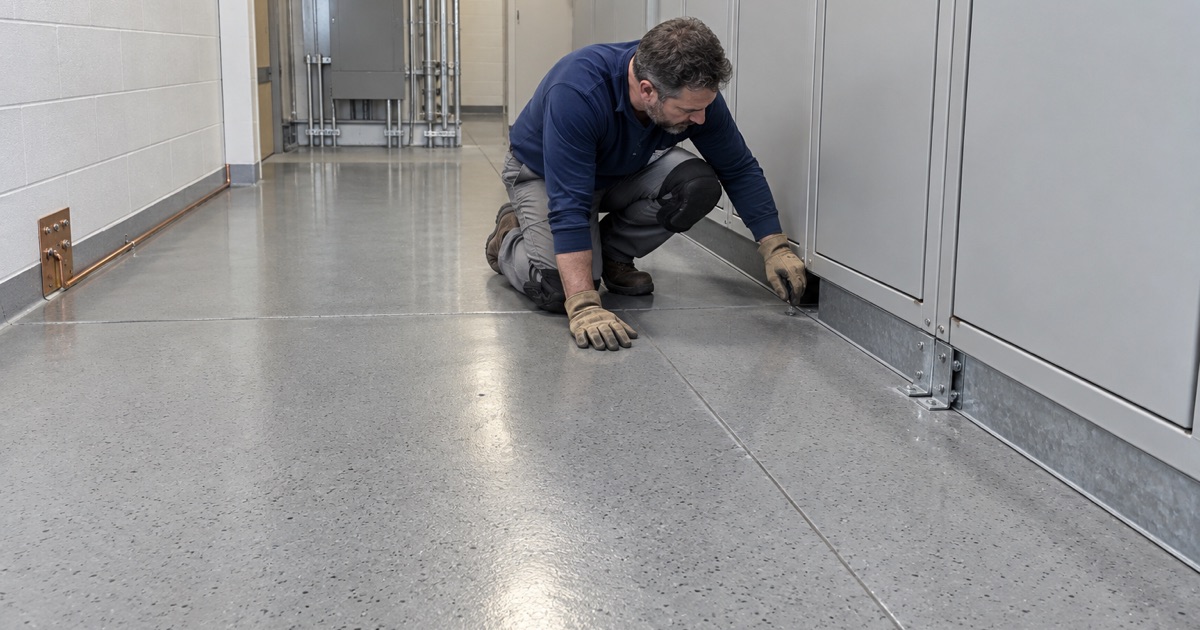
An ESD epoxy floor typically includes a conductive primer or layer, copper grounding strips tied to designated ground points, and a top layer with conductive or dissipative additives. Each layer has to be continuous and properly connected for the system to work.
Ground points are provided by the electrical contractor or the facility, and their number and placement follow the specification. We confirm the layout before coating, because a floor that is not properly grounded can look perfect and still fail its resistance test.
People, footwear and procedures
A floor alone does not control static. People generate charge as they move, and that charge reaches the floor through their footwear. Static control programs usually require ESD footwear or heel grounders so the floor can do its job.
We point this out early, because owners sometimes expect the floor to solve the problem by itself. The best results come when the floor, footwear, workstations and procedures are planned together.
Where ESD Floors Are Used
Electronics assembly and repair
Electronics assembly, repair benches and testing areas handle components that can be damaged by discharges too small for a person to feel. A static control floor helps keep charge levels low throughout the room, not just at individual workstations.
These spaces also need floors that are smooth, easy to clean and resistant to rolling carts and chairs. ESD epoxy delivers those properties along with static control.
Server, data and electrical rooms
Server rooms, data halls and electrical rooms often call for static control flooring, depending on the owner’s standards and equipment requirements. West Des Moines has a growing data center presence, and rooms like these are usually built to detailed owner specifications.
We build to the specification we are given and coordinate with the electrical contractor and facility team on grounding. We do not claim work on any particular campus or facility.
Labs and light manufacturing
Labs, clean manufacturing and some warehouse areas that handle electronic goods may use ESD flooring in defined zones. Those zones are often marked with a different color so workers know where static control rules apply.
We can install ESD flooring in one area and a standard coating in the rest of the space, with a clean transition between them. Limiting the static control system to the zones that need it keeps the cost focused where it matters.
Preparing and Testing the Slab
Grinding and moisture testing
An ESD floor needs the same sound substrate as any other coating. We grind the slab to the profile the product requires, repair cracks and joints, and capture grinding dust at the machine so it does not settle into sensitive equipment nearby.
Moisture testing is part of the written scope. We use ASTM F2170 relative humidity probes or ASTM F1869 calcium chloride tests, and moisture is the first exclusion we name in the coating warranty, as with any other system.
Measuring resistance at handover
After installation and cure, we measure resistance across the floor using the method and range named in the specification. Readings are taken at multiple points and recorded, along with the conditions at the time of testing.
Those results go to the owner as a baseline. ESD floors should be tested periodically, and having the original readings makes it easier to spot changes over time.
Joints, transitions and doorways
Control joints, doorways and the edges where an ESD zone meets an ordinary floor all need planning. The conductive layer has to stay continuous across the area it serves, and joints are filled and detailed so they do not break that path or trap debris that wheels and carts will catch.
At the edge of a zone, we finish with a clean transition and a color change where the owner wants one, so people can see where static control rules begin. Those details are drawn into the plan before coating rather than worked out on the day.
Caring for an ESD Floor
Cleaning products and floor finishes can affect how an ESD floor performs. Some waxes and polishes insulate the surface and raise resistance, defeating the purpose of the system.
We provide care guidance with each floor, including which cleaners are compatible and what to avoid. Regular testing, combined with the right cleaning routine, helps the floor stay within its range for years.
- 20+ Years in Epoxy Flooring
- Moisture Tested Before Pricing
- Coats and Thickness in Writing