
West Des Moines Epoxy Flooring installs industrial epoxy flooring in West Des Moines, IA, serving surrounding cities including Clive, Windsor Heights, Waukee, Urbandale and Norwalk. Our more than 20 years on concrete include warehouse aisles, shop floors and production areas, and the lesson from all of them is the same: an industrial floor fails at its weakest point, which is usually the slab preparation, a joint or the wrong system for the load.
Industrial floors take forklifts, pallet jacks, dropped parts, chemicals, oils and cleaning that would wear through a residential coating in months. We choose systems by duty: thin films for light traffic, thicker slurry and mortar systems for impact and heavy loads, and urethane cement where heat, steam or aggressive chemicals are part of the work.
Every industrial slab is shot blasted or diamond ground, tested for moisture and mapped for cracks, spalls and joint damage before pricing. The proposal names the product line, the coats and the finished thickness for each zone, so the plant engineer or facility manager can check the finished floor against the quote.
Matching the System to the Load
Film, slurry and mortar systems
Industrial coatings range from thin rolled films to thick troweled mortars. Thin films suit light foot traffic, storage and clean assembly areas. Slurry systems add thickness and impact resistance for moderate traffic, while troweled mortars handle heavy forklifts, dropped loads and rough use.
We look at the heaviest thing that will regularly happen to each part of the floor and choose a system for that, rather than using one system for the whole building. A shipping dock, a production aisle and a break room rarely need the same floor.
Chemical exposure
Oils, coolants, fuels, cleaning chemicals and process fluids all affect coatings differently. We ask which chemicals reach the floor, how often and at what temperature, and choose a system rated for that exposure.
Some areas need a chemical-resistant topcoat, while others need a different resin system entirely. We check manufacturer resistance data against your process before recommending a product line.
Heat, washdown and urethane cement
Hot water washdowns, steam cleaning and thermal shock can soften or crack standard epoxy. Urethane cement is designed to tolerate those conditions and is common in food production, wash bays and areas cleaned with hot water.
We recommend urethane cement where it fits and explain the cost difference compared with epoxy. In dry warehouses and assembly areas, an epoxy system is often the better value.
Preparing an Industrial Slab
Shot blasting and grinding
Large open areas are often shot blasted to create an even surface profile quickly, while edges, corners and areas around equipment are diamond ground. Both methods remove laitance, old coatings and contamination so the new system bonds to sound concrete.
Dust is captured at the machine with industrial vacuums, which matters in buildings with running equipment and finished goods nearby. Waste is collected rather than rinsed toward floor drains.
Oil-soaked concrete
Floors that have carried oil and coolant for years often have contamination soaked into the slab. Coatings will not bond to oil-saturated concrete, so these areas need cleaning, degreasing and sometimes removal of the contaminated layer.
We test oily areas during preparation and adjust the plan if contamination runs deep. In some cases, a section of concrete must be cut out and replaced before coating.
Joints and slab movement
Industrial slabs have control and construction joints that move with temperature and load. Forklift wheels batter joint edges, and broken joints become trip hazards and shake loads.
We repair spalled joint edges and fill moving joints with a semi-rigid filler that supports wheels while allowing movement. Coating directly over a working joint usually results in a crack along its length, so we treat joints as part of the floor design.
Scheduling Around Production
Zoning the work
Plants and warehouses rarely shut down completely. We divide the floor into zones, coordinate with your operations team, and use overnight and weekend windows where needed so lines, racks and aisles keep moving.
Each zone is prepared, coated and cured before it returns to service. Cure times depend on the system and slab temperature, and we confirm them on the day.
Cure conditions in industrial buildings
Large buildings can have cold slabs near docks and overhead doors, especially in winter. Resin needs the slab to be warm enough and safely above the dew point to cure properly.
We measure slab temperature and dew point spread before coating and may recommend temporary heat or a different schedule for cold areas. Coating a cold, damp slab invites amine blush and weak adhesion.
Safety Markings and Testing
Aisle lines, color zones and walkways
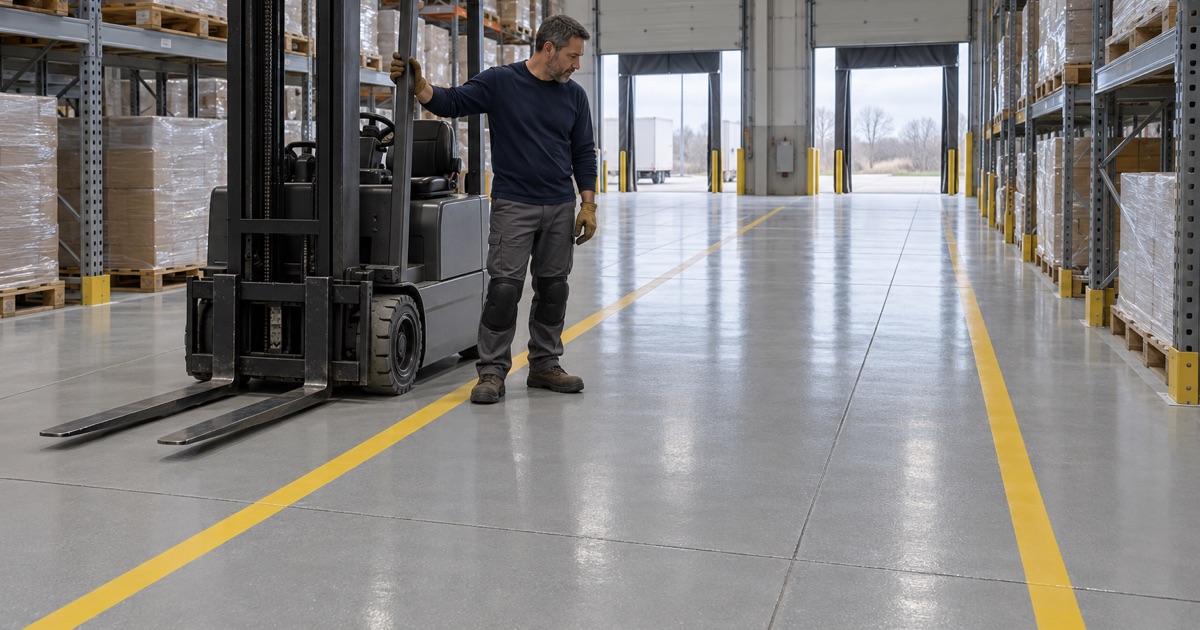
Aisle lines, color zones and pedestrian walkways can be built into the coating system so they wear with the floor rather than flaking off like paint on bare concrete. The layout follows your safety plan, and we set it out with the operations team before any color goes down so racking, doors and equipment line up with it.
A quartz aggregate broadcast or a grit in the topcoat can add texture in walkways, ramps and wet areas while the forklift lanes stay smoother. We specify that texture by the materials used, so the floor is built to the plan rather than described with a general promise.
Moisture testing and the written scope
Before pricing, we test moisture with ASTM F2170 relative humidity probes or ASTM F1869 calcium chloride tests, placed across the building rather than in a single spot. Older industrial buildings often have slabs without an under-slab vapor retarder, and new ones may still be drying out from placement.
Moisture is the first exclusion we name in the coating warranty. The readings, any moisture-mitigation primer and the system for each zone all go into the proposal, so the facility team can see why each decision was made.
- 20+ Years in Epoxy Flooring
- Moisture Tested Before Pricing
- Coats and Thickness in Writing