
West Des Moines Epoxy Flooring pours metallic epoxy floors in West Des Moines, IA, serving surrounding cities including Clive, Windsor Heights, Waukee, Urbandale and Norwalk. We have spent more than 20 years on concrete, and metallic work is where that experience shows most, because a marbled, glossy finish puts every flaw in the slab and every misstep in the pour on display for as long as the floor is down.
A metallic floor is built from a clear or tinted epoxy carrying metallic pigments that drift and swirl as the resin levels out. The result looks like polished stone, molten metal or deep water, depending on the colors and how they are worked. It suits finished lower levels, showrooms, offices and retail spaces where the floor is part of the design rather than simply a surface to walk on.
Because the finish is so revealing, the preparation matters even more than usual. We grind every slab with diamond tooling or a shot blaster rather than etching it, test it for moisture, and map cracks and old coatings before pricing. The proposal names the product line, the colors, the number of coats and the finished thickness, so you know exactly what is going down and can measure the floor against it.
How a Metallic Epoxy Floor Gets Its Look
Pigment, resin and movement
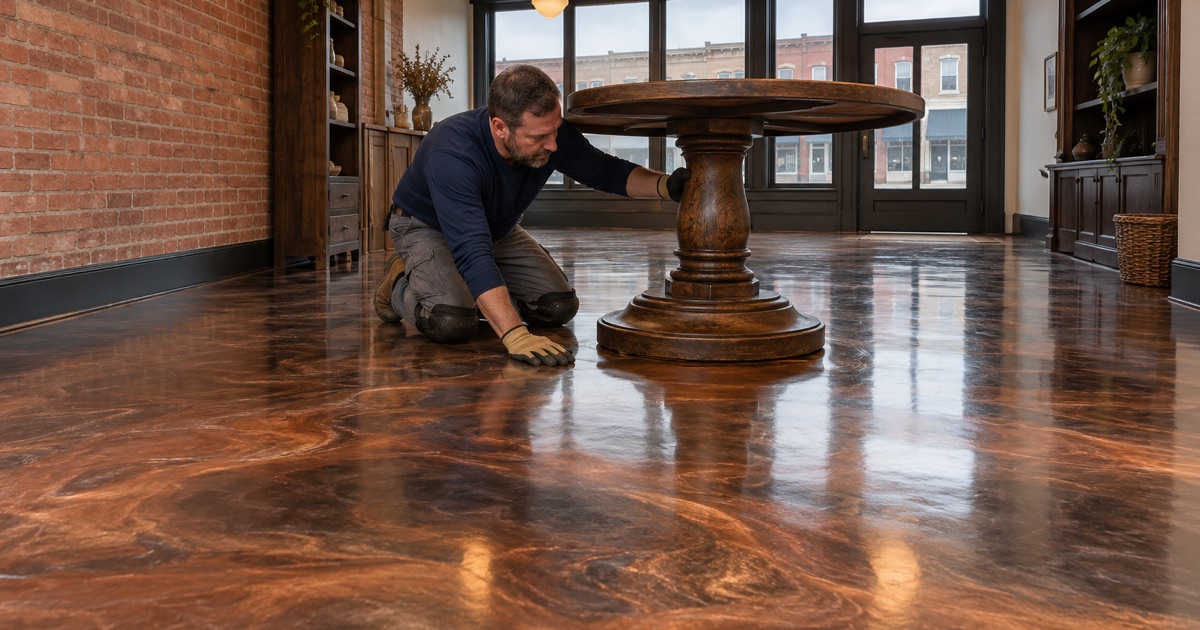
Metallic pigments are fine, reflective particles mixed into the epoxy. As the resin flows across the floor, those particles shift and settle, creating veins, clouds and ripples that catch the light from different angles. The movement depends on how the material is placed and worked while it is still wet, which is why two floors with the same colors never look exactly alike.
The installer’s hand is part of the result. Rolling, back-rolling, spraying a solvent mist or working the surface with a trowel each produce a different kind of pattern. We agree on the look you want before the pour and then work steadily toward it, rather than improvising across the floor and hoping the sections blend together.
Color choices and layering
Most metallic floors use a base color with one or more accent colors worked into it. Neutral grays and pewter tones suit offices and modern lower levels, while deeper blues, coppers and bronzes make a stronger statement in a showroom or a bar area. Light colors show more of the movement but also more of any dust or blemish in the slab.
We help you choose a palette that fits the room’s lighting, furniture and use. A floor that looks dramatic in a sample photo can feel very busy across a large basement, and a subtle palette can disappear under heavy lighting. Seeing the colors in your own space before committing saves surprises later.
Why every metallic floor is one of a kind
The same features that make a metallic floor striking also make it impossible to reproduce exactly. If a small area is damaged later, the patch will not match the surrounding pattern perfectly, so it is worth planning protection from the start.
That uniqueness is also part of the appeal. A metallic floor reads as a deliberate design choice, and in spaces like showrooms and entertaining areas it gives the room a finish that no tile or carpet can match. We make sure you understand both sides before you choose it.
Where Metallic Epoxy Works Well
Finished basements and walkout lower levels
Metallic finishes are popular in finished basements, media rooms and walkout lower levels, where they turn a plain slab into a feature floor. Before that happens, we read the basement for past water, check the sump pit and drain tile, and test moisture, because a basement slab carries moisture risk that a glossy coating will reveal quickly.
Walkouts bring sunlight through large doors and windows. Epoxy can amber over time in direct ultraviolet light, which is more visible on lighter metallic colors. For those floors, we specify a UV-stable topcoat to keep the color true where the sun reaches it.
Showrooms, offices and retail spaces
In commercial spaces, a metallic floor can carry a brand color or set a tone in a lobby or showroom. It is seamless, easy to clean and stands up well to foot traffic when protected by the right topcoat.
We plan commercial installs around business hours, with overnight and weekend windows where a space cannot close. Grinding dust is collected at the machine with a vacuum, and each phase is scheduled so the space can reopen with the floor fully cured.
Garages and the limits of a smooth finish
Metallic epoxy can be used in garages, but it is less forgiving there than a flake system. Salt residue, tire marks and scratches show more readily on a smooth, glossy surface, and the brine that rides in on tires from November through March leaves visible rings if it is not cleaned up.
If you want a metallic garage floor, we recommend a hard-wearing topcoat with an added grit for traction and a regular cleaning routine through the winter. For many garages, a flake floor is the more practical choice, and we will say so.
What a Metallic Floor Demands of the Slab
Flatness and a thorough grind
A metallic finish exaggerates every dip, ridge and trowel mark in the concrete. Low spots collect more pigment and look darker, and high spots look thin. We grind the slab to a consistent surface profile, fill cracks and spalls, and level problem areas before the primer goes down.
Old coatings, sealers and adhesive have to come off completely. Any residue left behind can cause fisheyes or poor adhesion that shows as a blemish in the finished floor, so we remove it all rather than coating over it.
Temperature, dew point and a clean cure
Metallic epoxy needs stable conditions while it levels and cures. If the slab is too cold or too close to the dew point, the resin can develop amine blush, a waxy film that dulls the surface and interferes with the next coat. On a glossy metallic floor, that defect is obvious.
We check slab temperature and the dew point spread before each coat and schedule by those readings, not by the calendar. In winter that may mean heating the space ahead of time or waiting for better conditions.
Topcoat and slip resistance
The metallic layer is protected by a clear topcoat that takes the daily wear. We choose that topcoat for abrasion resistance, UV stability and the sheen you want, from high gloss to satin.
Slip resistance is specified, not promised. In areas near entries, bathrooms or bars, we can add a fine grit to the topcoat, and we show you how that affects the look before deciding.
Our Step-by-Step Metallic Epoxy Floor Process
Step 1: Inspect, test and choose the palette
We walk the space, map cracks and old coatings, place moisture tests and talk through colors and patterns. You see sample boards and, if you want, a small sample panel in your chosen palette before the proposal is finalized.
Step 2: Grind, repair and prime
The slab is diamond ground with dust captured at the machine, cracks and spalls are filled and leveled, and a primer is applied. If testing calls for it, a moisture-mitigation primer goes down first.
Step 3: Pour and work the metallic coat
The metallic epoxy is mixed in planned batches and placed across the floor in a set sequence, then worked to create the movement we agreed on. The space stays closed while the coat levels and cures.
Step 4: Topcoat and hand back
A clear topcoat goes on once the metallic layer has cured enough. We confirm cure times for foot traffic and furniture, give you care instructions, and walk the finished floor with you.
- 20+ Years in Epoxy Flooring
- Moisture Tested Before Pricing
- Coats and Thickness in Writing