
West Des Moines Epoxy Flooring applies polyaspartic floor coating systems in West Des Moines, IA, serving surrounding cities including Clive, Windsor Heights, Waukee, Urbandale and Norwalk. After more than 20 years of coating concrete, we use polyaspartic where its strengths matter most: fast return to service and color that holds up in the sun.
Polyaspartic is a fast-curing coating related to polyurea. It can be used as a clear or pigmented topcoat over an epoxy base, or as a full system with its own base coats. Either way, it is only as good as the bond to the concrete under it, so we grind every slab to a real profile and test it for moisture before writing a price.
The proposal spells out which product line we are using, the number of coats and the finished thickness. If a slab is not ready for a coating, whether because of moisture, movement or old layers, the proposal says that too.
What a Polyaspartic Coating Is
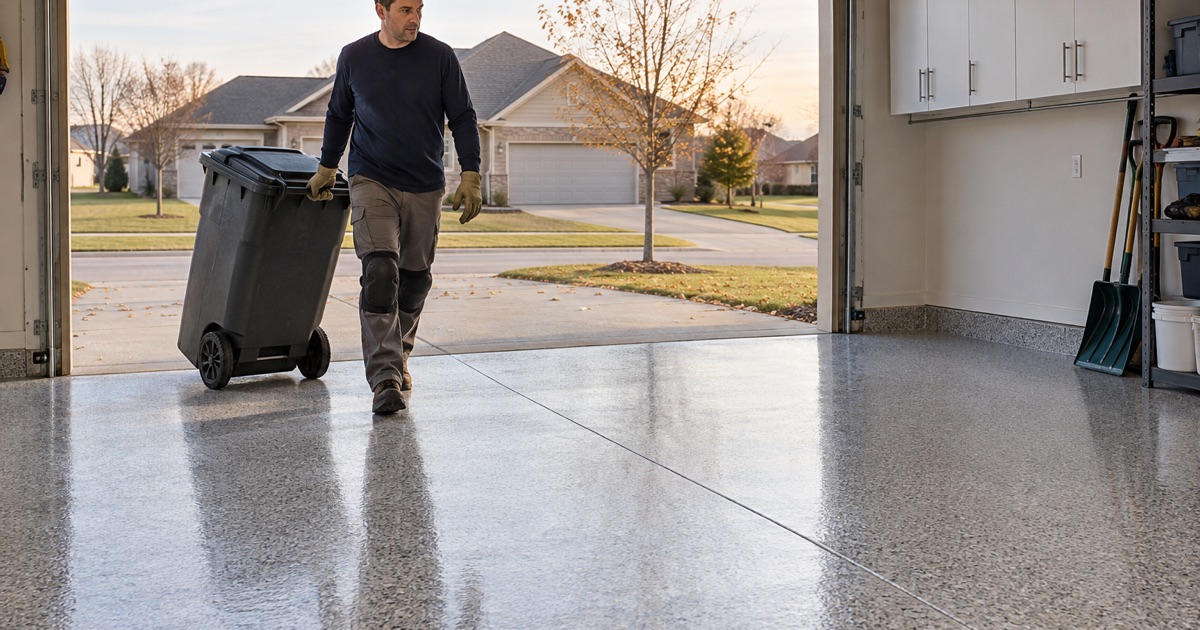
A fast-curing relative of polyurea
Polyaspartic coatings are aliphatic polyureas, built to cure much faster than conventional epoxy. A floor can often take foot traffic within hours, and vehicles sooner than with an epoxy-only system. That speed is why polyaspartic shows up so often in garage and commercial work where downtime is expensive.
The fast cure is also why installation takes a practiced crew. Material is mixed in smaller batches and spread within a short working window, and there is little time to fix a missed spot before the coat sets.
Holding color in sunlight
Many epoxies amber, or yellow, when ultraviolet light hits them over time. Polyaspartic coatings are designed to resist that, which makes them a better finish near open garage doors, walkout sliders, storefront glass and anywhere the afternoon sun falls on the floor.
That UV stability is the main reason we put a polyaspartic topcoat over an epoxy flake base. The epoxy builds thickness and bonds to the slab, while the polyaspartic on top keeps the color true and takes the daily abrasion.
Topcoat or full system
On many floors polyaspartic is the topcoat only. On others, especially where a fast return to service matters most, we use it as the base and the topcoat. Which one fits depends on the slab, the moisture readings and how quickly you need the floor back.
The choice affects price and performance. A full polyaspartic system usually costs more per square foot in materials, while an epoxy base gives more build at a lower material cost. We explain the trade-off in plain numbers in the proposal.
The Fast Cure Has Limits
Speed does not fix a damp slab
A fast cure does nothing about moisture coming up through the concrete. If vapor drive is high, the coating can still blister or lose its bond. We test with ASTM F2170 relative humidity probes or ASTM F1869 calcium chloride tests before quoting, and add a moisture-mitigation primer where the readings call for it.
Moisture is also the first exclusion we name in any coating warranty. Most product warranties do not cover failures from moisture vapor transmission or hydrostatic pressure, and we tell you that before you sign rather than after.
The truth about one-day floors
A one-day polyaspartic garage floor is possible when the slab is sound, dry and warm, and needs only grinding and minor filling. Many floors are not that simple. Wide cracks, spalled joints, old coatings and high moisture all add steps that cannot be rushed.
We do not sell a one-day floor before we have seen the slab. The schedule comes from the map and the moisture readings, and if your floor needs more time, the proposal says so.
Short working time and careful mixing
Because polyaspartic sets quickly, it is mixed in smaller batches and applied in a planned sequence. Edges, corners and drains are cut in first, and the open areas follow before the material begins to set.
Humidity and slab temperature change how fast that happens. We read both on the day and adjust batch size and pace, rather than following a fixed timing chart.
Where Polyaspartic Fits Best
Garages that see sun and salt
A garage with a west-facing door or a driveway that bakes in the afternoon is a good fit for a polyaspartic topcoat. It holds its color where the sun hits, resists hot tire pickup when built over a proper base, and stands up to the brine and rock salt that ride in from November through March.
We usually pair it with a vinyl flake broadcast for texture and to hide dust, and we specify any added grit in the proposal instead of promising slip resistance as a slogan.
Walkouts, sunrooms and lower levels
Walkout lower levels and rooms with large windows get more sunlight than a typical basement. A polyaspartic finish there keeps light-colored floors from ambering.
We still treat these as below-grade or near-grade slabs. That means checking the sump pit and drain tile, looking for efflorescence and testing moisture before deciding on the system.
Commercial floors with little downtime
Retail spaces, showrooms and offices often cannot close for several days. A polyaspartic system can shorten the time an area is out of service, which makes phased overnight or weekend work more practical.
We plan these jobs zone by zone and capture grinding dust at the machine so the open parts of the space stay clean. Return-to-service times are confirmed from the slab conditions on the day of installation, not from a brochure.
Temperature, Humidity and Odor
Cold slabs and the dew point
Polyaspartic can cure at lower temperatures than many epoxies, which is one reason it is used for shoulder-season work. But the slab must still be dry and above the dew point by a safe margin. Moisture condensing on a cold slab can cause bubbles, haze and a weak bond.
We measure slab temperature and the dew point spread before starting. An unheated garage in a central Iowa winter can still fall short, and when it does we recommend waiting.
Low-odor choices for occupied spaces
Some polyaspartic products have a strong odor during application. Low-odor options are available, and we offer them for attached garages, basements and occupied businesses as a comfort and re-entry choice.
Iowa does not require low-odor products. Floor coatings sold nationally are covered by the federal 40 CFR 59 Subpart D VOC limits, and we can tell you which product line meets the comfort level you want.
Return-to-service times you can plan around
Foot traffic, light use and vehicles each come back at different points after the last coat, and those points shift with slab temperature and humidity. We give you each time at the end of the job, based on the product line and the readings that day, rather than a single number promised in advance.
For a business, that means we can tell you which zone opens first and plan the next phase around it. For a home, it means knowing when the garage can take a car again and when a heavy freezer or tool chest can roll back into place.
Caring for a Polyaspartic Floor
Routine cleaning
A polyaspartic floor cleans with a soft broom, a dust mop and a damp mop with a neutral cleaner. Salt residue in a garage rinses off with water and a squeegee, and a stiff brush handles tire marks on a textured flake floor.
Avoid harsh acidic cleaners and solvents unless the product line lists them as safe. They will not dissolve the coating outright, but repeated use can dull the sheen over time and make the floor look older than it is.
Scratches, impact and recoating
Polyaspartic resists abrasion well, but a dropped tool or a dragged steel stand can still scratch it. Felt pads under furniture and a plywood sheet under jack stands go a long way.
When a well-bonded floor starts to look worn after years of use, it can usually be cleaned, abraded and given a fresh topcoat rather than being ground back to bare concrete. We check the bond before recommending that, because a recoat over a failing layer only delays the problem.
- 20+ Years in Epoxy Flooring
- Moisture Tested Before Pricing
- Coats and Thickness in Writing