
West Des Moines Epoxy Flooring grinds and finishes polished concrete floors in West Des Moines, IA, serving surrounding cities including Clive, Windsor Heights, Waukee, Urbandale and Norwalk. With more than 20 years on concrete, we treat polishing as a grinding job first and a finish second, because the shine is only as good as the passes that come before it.
Polished concrete is not a coating. It is the slab, cut down with diamond tooling, hardened with a densifier and refined through progressively finer grits until it reflects light. Because nothing sits on top, nothing can peel, which makes it a strong choice for spaces that see steady foot traffic and rolling loads.
The proposal names the grind level, the densifier, the final grit and any guard, so you can hold the finished floor up against what was quoted. It also names what the slab cannot give, such as a uniform look over old patches, before any work begins.
How a Polished Concrete Floor Is Made
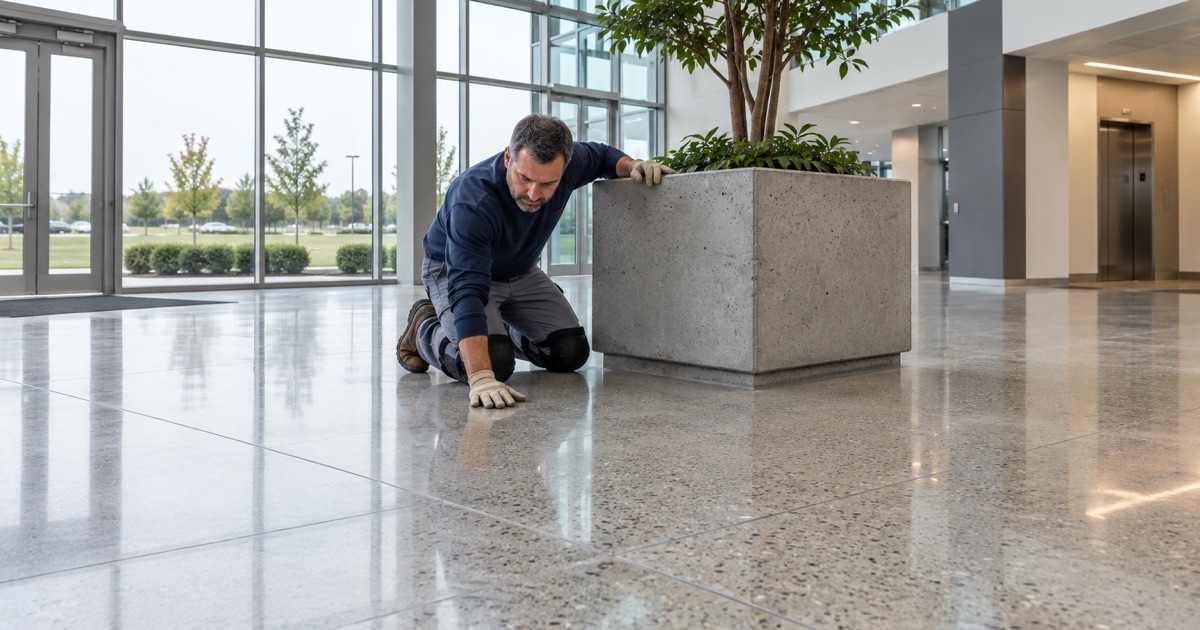
The grind and the aggregate it exposes
The first passes decide what the floor looks like. A light grind takes off the surface paste and leaves a cream finish with little stone showing. A medium grind opens the top of the aggregate for a salt-and-pepper look, and a deeper grind exposes larger stone across the floor.
How much stone a slab holds depends on how it was placed and finished, which we cannot see until the grinder has opened it up. That is why we grind a test area first. You see your own slab, not a sample board, before the full floor is committed to one look.
Densifying with lithium silicate
After the coarse passes, we apply a lithium silicate densifier. It reacts with the concrete near the surface and hardens it, which reduces dusting and lets the finer diamonds produce a tighter, more even finish.
Timing matters. Densifier applied too early is ground away, and too late leaves the softer surface exposed during the passes that need it most. We follow the sequence the product calls for and let it react fully before the next grit.
Polishing grits, sheen and a guard
The finer resin-bonded diamonds raise the sheen step by step, from a low satin to a high polish. Showrooms and lobbies often go glossier, while warehouses and back rooms usually stop at a lower sheen that shows less wear.
Many floors finish with a penetrating guard or stain protector that helps resist spills such as coffee, oil or cleaning chemicals. It is not a thick coating, and the proposal says exactly which product is used and how often the floor will need it refreshed.
Commercial Polished Concrete Floors
Warehouses, showrooms and retail floors
In warehouses and retail spaces, polished concrete stands up to forklifts, pallet jacks and carts without a film to wear through. The lighter surface also reflects more light, which can make aisles and display areas feel brighter.
Joints get attention before the shine. We fill and repair joint edges that have chipped under wheels, because a polished floor with broken joints still rattles carts and collects debris. Joint filler is chosen for the traffic the floor actually sees.
Offices, lobbies and occupied buildings
Office lobbies, corridors and break rooms need to look finished on Monday morning. We phase the work by zone around business hours and use overnight and weekend windows when a space cannot close.
Grinding dust is captured at the machine with a vacuum, not swept or washed toward a floor drain. That keeps dust out of an occupied building’s air and equipment and keeps the slurry out of the drains.
Keeping a commercial floor polished
A polished floor is cleaned, not stripped and waxed. Daily dust mopping and an auto scrubber with a neutral cleaner keep it looking right, while acidic or harsh degreasing cleaners can dull it over time.
Heavy traffic lanes eventually lose some sheen. Rather than recoating the whole floor, those lanes can be burnished or lightly repolished. We explain the maintenance plan with the proposal so the facility team knows what to expect.
Residential Polished Concrete Floors
Finished basements and walkout lower levels
A polished basement or walkout floor turns the slab into the finished surface. It works well with rugs and furniture, and since there is no film, it does not peel the way a coating can on a damp slab.
That does not make moisture irrelevant. We still read the basement for past water, check the sump pit and the drain tile, and look for efflorescence. Salts carried up by moisture can leave white deposits on a polished surface, and a floor that takes on water needs that fixed first.
New homes and new slabs
The best polished floors are often planned before the concrete is poured, when the mix, the finishing and the protection of the slab during framing can all be set with polishing in mind. A slab that has been scarred by trades is harder to bring to an even finish.
If you are building, we can walk the slab before the walls go up and talk about what to protect. An unfinished basement is also easier to grind edge to edge before it is framed.
Garages and polished concrete
Polished concrete can be used in a garage, but it is a weaker fit there than a coated floor. Road brine and rock salt can stain or etch the surface, and oil drips can soak into it.
For a garage in central Iowa, we usually recommend a coated flake or polyaspartic system, which keeps salt and oil on top. If you prefer the look of concrete, a guarded polish can work in a garage that sees little winter driving.
What a Slab Can and Cannot Give
Cracks, patches and saw joints
Polishing refines the slab; it does not hide it. Cracks, old patches, and saw-cut joints all stay visible. We can fill cracks with a color-matched filler, but they will still read as lines in the floor.
We map these before the price is set and tell you plainly if a slab has too many patches or too much damage for the look you want. In that case a coating or a different finish may serve you better.
Old coatings, mastic and tile glue
Many floors come to us under paint, epoxy, tile adhesive or carpet glue. All of it has to be ground off before polishing can start, and black mastic in particular adds time.
We test and remove these layers, then show you the slab before committing to polish. Old adhesive shadows and tack-strip holes may remain, which suits some spaces and not others.
Polishing compared with a coated floor
Polished concrete and a resin coating solve different problems. A polished slab has no film to peel or scratch through, needs no recoat cycle, and suits dry spaces with steady foot traffic and rolling loads. A coating hides a scarred slab, adds color and texture, and keeps chemicals, oil and salt brine on top of the concrete instead of letting them reach it.
Kitchens with hot washdowns, garages under road salt and shops with oil and solvent spills are usually better served by a coating such as urethane cement or a flake system. Showrooms, offices, warehouse aisles and finished lower levels are where polishing tends to earn its place. We recommend whichever fits the room, even when that means quoting the other service.
Some owners split the difference: a polished slab in the front of the house and a coated floor in the wash bay or the kitchen. That is a sensible plan when the uses really are different, and we price each area on its own terms.
- 20+ Years in Epoxy Flooring
- Moisture Tested Before Pricing
- Coats and Thickness in Writing